Customised wooden pallets – as a solution for demanding loads
Introduction – When a standard palette is not enough
The pallet is the basis of transport and storage. It makes quick loading, safe transport of goods and efficient logistics in warehouses possible. However, not every load fits into a standardised solution such as the Europallet. Large machines, atypical modules, construction elements or sensitive equipment require an individual approach. In such cases, customised wooden pallets are the best solution.
These are packages designed according to customer requirements – both in terms of dimensions, load capacity and additional reinforcements. This makes it possible to transport even the most demanding loads safely and economically.

What are customised pallets and how are they made?
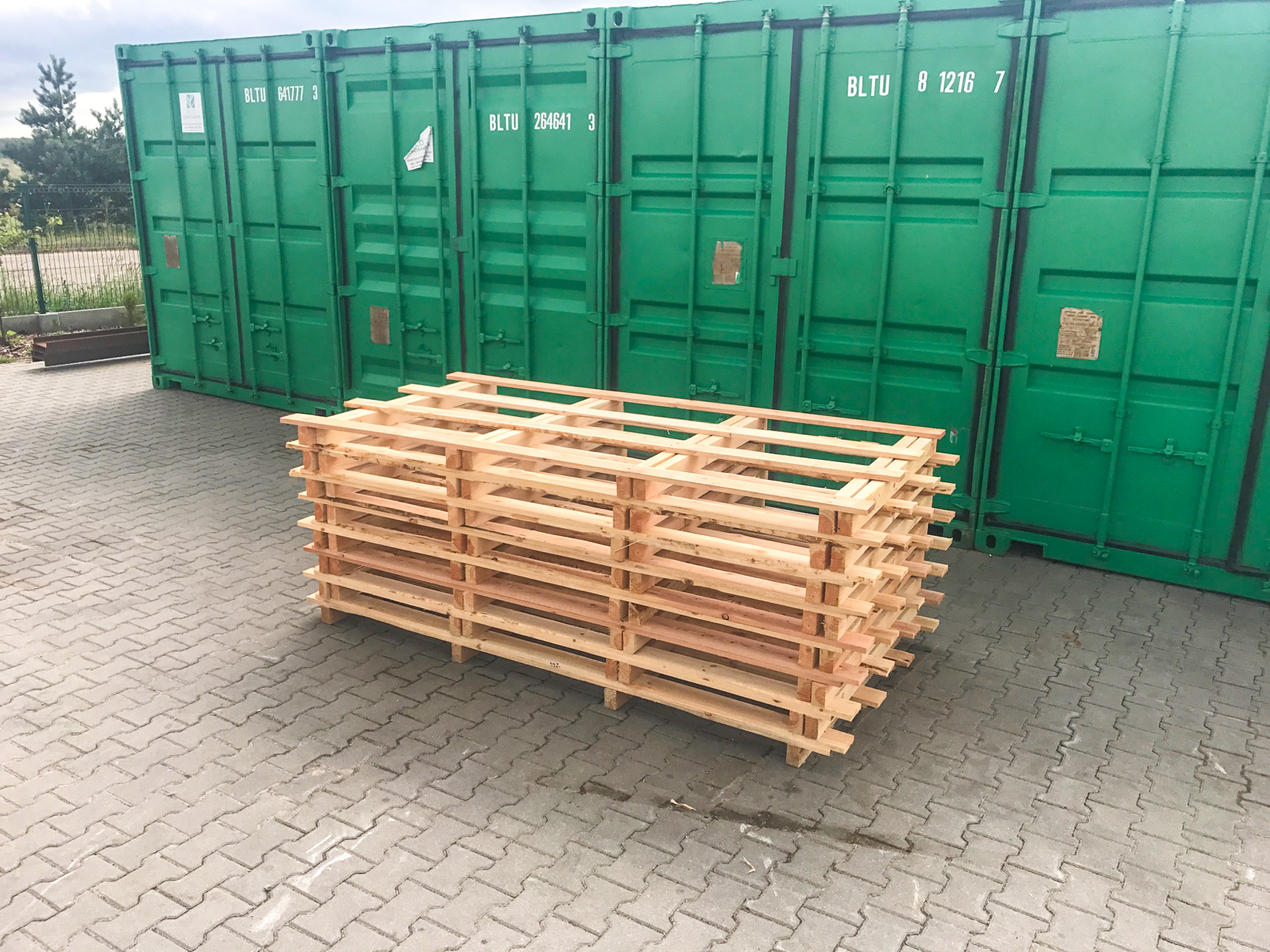
Customised wooden pallets are constructions that differ from standard Euro pallets in dimensions, thickness of elements and technical solutions used. They are based on:
- analysis of customer requirements,
- the dimensions and weight of the load,
- mode of transport (road, sea, air),
- storage time.
The production of bespoke pallets is made from kiln-dried timber in accordance with ISPM-15 requirements – this allows each pallet to be used for export. At Danpol, drying is additionally used in conditions that exceed the standards, which guarantees higher durability and resistance of the wood.
When is it a good idea to choose made-to-measure pallets?
Timber pallets made to measure are primarily chosen in situations where:
- the load is of an unusual size,
- weight of goods requires reinforced construction,
- transport takes place under difficult conditions (sea voyages, long storage),
- space needs to be optimised in a container or warehouse.
With personalisation, it is possible to create a pallet that fits the load perfectly and reduces the risk of damage in transit.
Transport of machinery, modules and production lines
Made-to-measure pallets are particularly well suited to the engineering and construction industries. They can be transported on them:
- industrial machinery and production equipment,
- process lines and their modules,
- prefabricated building components and steel structures,
- large-scale components requiring special reinforcements.
Thanks to the individual design, each pallet can be tailored to a specific machine or module. This solution significantly increases transport safety and reduces the risk of damage.

Industries using made-to-measure wooden pallets
The most common use of this type of solution:
- machinery industry – transport of heavy and large equipment,
- construction – prefabricated elements, steel modules, structures,
- power generation – transformers, generators, plant components,
- contract logistics – unusual customer orders that require dedicated pallets,
- event and exhibition industry – stand components and modules that do not fit on standard pallets.
Load capacity and strength of pallets made to measure
Bespoke pallets are designed with specific requirements in mind. They can have:
- reinforced beams and planks,
- additional legs or supports,
- special holders for attaching the straps,
- anti-slip surfaces.
The standard EURO pallet can withstand up to 1,500 kg, but made-to-measure pallets can be designed for much higher load capacities – up to several tonnes, depending on the customer’s needs.
Utility economics and logistics
Although customised pallets are more expensive than standard pallets, in many cases they prove to be more economical. This is due to the fact that they fit the load perfectly:
- minimise the risk of damage,
- allow a more optimal use of space in the container,
- reduce loading and unloading times.
For companies exporting machinery and equipment on a large scale, this is an investment that translates into real savings throughout the logistics process.
Check out our range of pallets, platforms and extensions

Ecology and recycling of pallets to size
Wooden pallets to size, like standard pallets, can be recycled and repaired. Components that wear out can be replaced and whole pallets can be put back into circulation.
This is a solution in line with the idea of a circular economy and ESG policy, increasingly required in large industrial companies.