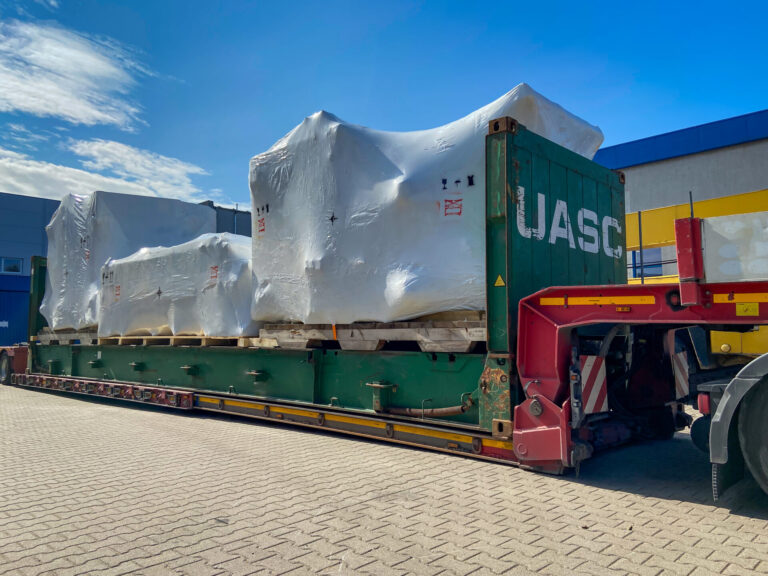

Wooden transport boxes – when are they the best choice and how do they protect the load?
Why are wooden transport boxes the foundation of exports?
In the world of international logistics, one of the biggest challenges is to ensure the safety of goods during multi-week journeys across oceans, deserts and mountains. Machines worth millions of zlotys, delicate electronic devices or heavy steel constructions have to reach their destination intact. This is a task that requires not only efficient transport organisation, but, above all, appropriate packaging.
Wooden transport boxes have remained the gold standard in this field for years. They are chosen by major exporters for their durability, versatility and compliance with international standards. Unlike cardboard or plastic packaging, they are able to protect cargo from shocks, moisture, temperature changes and even tampering.
At Danpol, crate production is based on experience and modern technology. Wood dried in our own drying facility, in conditions exceeding ISPM-15 standards, guarantees the highest quality and full acceptance in global transport. It is the combination of tradition and modernity that makes wooden crates remain the foundation of exports.
What are wooden transport boxes and what are they made of?
Wooden transport boxes are sturdy structural packaging that are made from planks and beams that form a skeleton capable of supporting loads of up to several tonnes. Coniferous or deciduous wood is used, carefully dried to meet phytosanitary requirements and ensure dimensional stability.
Thanks to their design, these boxes can range from simple, open packages to full boxes with a lid, fitted with additional reinforcements. They can be designed for a specific load: from delicate measuring devices to giant industrial generators.
Why wood?
- is a natural, renewable material,
- has an excellent strength-to-weight ratio,
- They are easy to machine and can be adapted to the dimensions of the load,
- absorbs shocks and protects against mechanical damage.
What standards must wooden crates meet for international transport?
International transport is governed by its own rules. Every exporter knows that without proper documentation and compliance with standards, goods can be detained at port. For wooden packaging, the ISPM-15 standard, developed by the International Plant Protection Organisation (IPPC), is crucial.
This standard requires that the wood used in the manufacture of the boxes be heat-treated under certain conditions – 56°C in the core for at least 30 minutes. The aim is to eliminate pests and micro-organisms that could endanger the environment in the target country.
Each compliant crate is marked with an IPPC stamp with the distinctive ear symbol, country code and certification body number. The absence of this marking can result in the cargo being detained, additional fumigation costs and even the entire consignment being recalled.
In practice, this means that without ISPM-15 compliant boxes, export is impossible. This is why it is so important to choose manufacturers with their own drying facilities and certifications.
Why does drying wood above ISPM-15 standards offer an advantage?
Most companies pack their goods in crates that comply with the minimum requirements of ISPM-15. Danpol goes a step further – the drying of the wood takes place under conditions that exceed the requirements of the standard. This not only eliminates phytosanitary risks, but also provides additional benefits:
- Structural stability – wood with lower moisture content works less, does not warp or crack.
- Packaging durability – the box can withstand longer periods of storage under varying conditions.
- Better load protection – dry wood minimises the risk of condensation inside the packaging.
This gives exporters confidence that their goods will survive even the longest ocean voyages.
Applications – in which industries do wooden transport boxes perform best?
The versatility of wooden crates means that they are used by companies in a wide variety of industries.
- Machinery industry – this is where wooden crates are standard. They protect milling machines, lathes, CNC machines or entire production lines.
- Energy – generators, transformers and turbine components require particularly robust packaging.
- Construction – steel modules, prefabricated elements and structural components are often shipped in bulky crates.
- Culture and art – musical instruments, museum exhibits, works of art. The cases have a protective and conservation role here.
Interesting fact: museums use special wooden boxes with cushioning inserts and humidity control, which can maintain the right conditions for a painting or sculpture even for several months of travel.
How long can goods be stored in a wooden box?
A wooden transport crate is not only a protection for the transport itself, but also for the storage period. In the case of sea transport, it is often the case that goods stand for weeks in ports or containers.
A simple wooden crate provides protection for short to medium transport times. But when combined with additional packaging methods – aluminium barrier film (ALU), VCI film with corrosion inhibitors or moisture dehumidifiers – this period can be extended up to 24 months.
This solution is particularly valuable for exporters of machinery and equipment, who cannot always anticipate delivery or storage times at their destination.
Can wooden crates be reused?
Yes – wooden transport boxes often act as reusable packaging. Their reuse depends on the type of wood, the construction and how they are protected.
Many of Danpol’s customers order crates designed for long-term use. Such boxes are additionally reinforced and fitted with fittings, which allows them to be opened and closed without losing their protective properties. This is an excellent solution, for example, for services that need to send and receive equipment repeatedly.
The economics here are obvious: a box that serves several years pays for itself many times over compared to disposable packaging.
Costs – how much does a wooden transport box cost?
The cost of a wooden box depends on:
- size – the larger the load, the greater the material required,
- thetype of wood – thickness and species affect the price,
- individual design – additional reinforcements, cushioning inserts, fittings,
- number of units – serial production reduces the cost per unit.
Example: a crate for a small electronic device may cost a few hundred zlotys, but a crate for an industrial generator – several thousand. It is worth remembering that the cost of the packaging is small compared to the potential losses resulting from damage to the cargo.
Check out our range of wooden transport boxes
Wooden boxes versus alternatives – which to choose?
Although wooden crates are the most commonly chosen solution, it is also worth knowing the alternatives:
- plywood – lighter, moisture-resistant, and readily used in air transport,
- OSB – cheaper and lighter, good for high shipping volumes,
- Plastic/metal – niche, expensive and difficult to recycle, used in specific industries.
The decision depends on priorities: weight, cost, durability or ecology. In practice, however, wood remains the golden mean – it gives the best compromise between price and durability.
Ecology and recycling of wooden crates
Wood is a renewable and biodegradable material, making wooden boxes much more environmentally friendly than plastic packaging.
Used crates can be recycled – into chipboard, firewood or furniture. Many companies are implementing ESG policies in which wood recycling becomes one of the elements of sustainability.
Danpol supports its customers in this regard by offering a collection and management service for wood waste. In this way, entrepreneurs not only get rid of the hassle, but also act in accordance with BDO regulations and take care of the environment.