
Transport cases for the energy and offshore sectors – requirements, certifications, common mistakes
The energy and offshore sectors are environments where there is virtually no margin for error when transporting components. A gas turbine worth several million euros, a medium-voltage transformer destined for an offshore platform, or wind farm control modules – each of these components requires a transport crate designed to withstand specific loads, climatic conditions and regulatory requirements. In this article, we describe the requirements faced by a transport crate manufacturer serving the energy sector, the necessary certifications, and the mistakes to avoid.
The specific nature of transport in the energy and offshore sectors
The energy sector encompasses a wide range of components requiring transport: from multi-tonne power transformers and gas turbines, through medium- and low-voltage switchgear and SCADA control cabinets, to delicate measurement sensors and telecommunications modules. Each of these categories has different requirements in terms of mechanical, anti-corrosion and climatic protection.
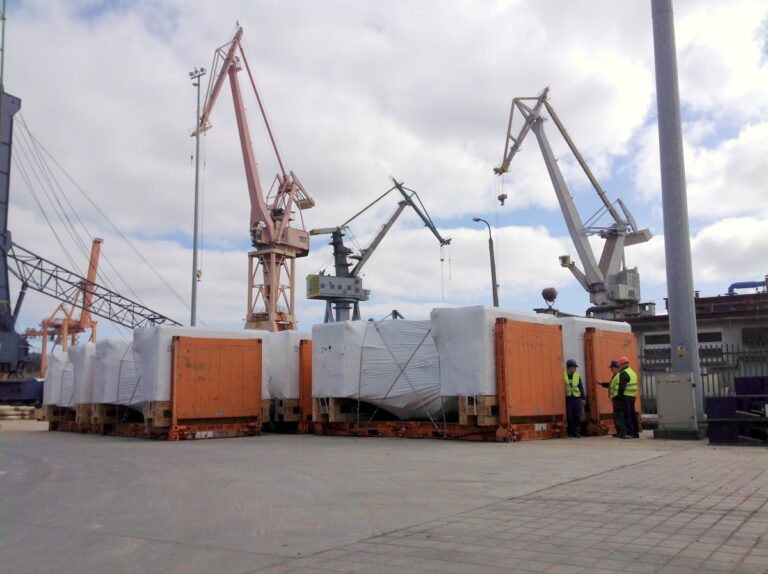
The offshore sector presents additional challenges. Components are delivered to drilling platforms, wind turbine installation vessels (WTIVs), offshore substations and wind farm foundations. Transport often takes place in extreme conditions – salty air, sea spray, dynamic accelerations during crane handling on the open sea, and engine vibrations from supply vessels (PSVs). A transport crate that works well for road transport simply won’t hold up in such conditions.
Added to this is regulatory pressure. Operators of offshore platforms and wind farms require full packaging documentation, compliance with phytosanitary standards and, in many cases, certification of packaging designs by marine classification societies. Failure to meet these requirements results in the cargo being refused on board, which, given that daily rates for installation vessels can reach several hundred thousand euros, generates colossal losses.
Requirements for transport crates in the energy sector
Structural strength and load distribution
Power components are often heavy loads with an uneven distribution of weight. A power transformer weighing 2–3 tonnes, whose centre of gravity is offset from the geometric centre of the box, requires a base with asymmetrical reinforcement – thicker side members under the heavier section and appropriately spaced skids. We design each skid taking into account the component’s technical drawings, and in the case of oversized loads, we carry out strength calculations for the base.
In maritime and offshore transport, a crate must withstand dynamic loads many times greater than those encountered in road transport. The DNV 2.7-1 standard (formerly EN 12079) for offshore containers and packaging specifies accelerations of up to 2 g vertically and 1 g horizontally as design criteria. This means that a crate carrying a 1-tonne load must withstand a downward force equivalent to 2 tonnes – a standard that cannot be met by crates built ‘by eye’, without calculations.
Construction materials and types of crates
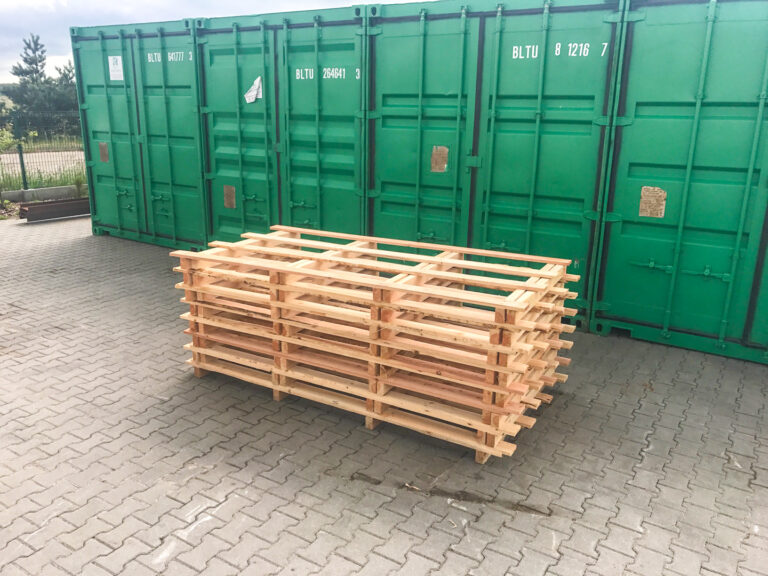
Depending on the weight of the load, the mode of transport and the customer’s requirements, we use different types of transport crates. Solid wood crates are ideal for components that are sensitive to dust and weather conditions. Openwork crates – which are lighter and cheaper – are used where ventilation or weight reduction is essential (air transport).
In the offshore sector, there is a growing demand for crates featuring metal components – such as stainless steel fittings, screw caps and certified lifting points. These components must be designed in accordance with the platform operator’s requirements and are often subject to a separate inspection before being allowed on board.
Corrosion and weather protection
The marine environment presents the most aggressive corrosive conditions that transport packaging has to contend with. Salt-laden air, humidity exceeding 95%, sea spray and condensation inside containers – all these factors act simultaneously. That is why, for projects in the offshore and energy sectors, we use comprehensive export packaging: VCI film (we use the American brand ZERUST/EXCOR), aluminium barrier film, vacuum packaging and desiccants selected to suit the volume of the packaging and the planned transport time.
For electronic components – SCADA systems, turbine controllers, telecommunications modules – we also use anti-static (ESD) protection and silica gel sachets to prevent condensation on printed circuit boards. Moisture indicators placed inside the packaging allow the recipient to immediately assess whether transport conditions have been compromised.
Certificates and standards applicable to the transport of power components
ISPM 15 – a mandatory phytosanitary standard
ISPM 15 certification is an absolute minimum requirement for the export of components in wooden shipping crates. The standard requires that the wood undergo heat treatment and be marked with an IPPC stamp that is permanently and legibly imprinted. In the energy sector, where shipments are sent to dozens of countries across every continent, the absence of this certificate means the goods are certain to be held up at customs clearance – and a delay in the delivery of a component critical to the commissioning of a power plant can cost the operator millions in lost revenue.
At Danpol, we hold ISPM 15 certification and maintain full control over the packaging timber production chain – from the purchase of raw materials, through heat treatment, to the assembly of the crates. Each batch of timber is marked with a certificate number and the date of treatment, ensuring full traceability in the event of a phytosanitary audit.
DNV 2.7-1 and EN 12079 – offshore requirements
The DNV 2.7-1 standard (International Standard for Offshore Containers) and its European counterpart, EN 12079, specify the design, material and testing requirements for transport packaging intended for lifting by crane on offshore platforms. Although they primarily concern steel containers, their design principles – calculations for dynamic loads, safety factors, and requirements for lifting points – are increasingly being applied by analogy to wooden crates in offshore projects.
In practice, this means that even a wooden shipping crate loaded onto an installation vessel must have a documented design, calculated load-bearing capacity at the fixing points, and a verified gross weight. Platform operators often require technical drawings of the crate, together with the manufacturer’s declaration of conformity, before the goods are dispatched.
Energy industry standards: IEC, NEMA and EPC contractors’ requirements
EPC contractors impose their own packaging specifications, which are often more stringent than international standards. Typical requirements include: a detailed packing procedure approved by a quality inspector, photographic documentation of each stage of packing, a declaration of conformity of packaging materials with project requirements, labelling in accordance with PO (Purchase Order) codes and TAG component numbers, and a packing list in a format agreed with the logistics department.
Our firm works with both OEM suppliers (manufacturers of turbines, transformers and switchgear) and EPC contractors delivering turnkey projects. We begin every project by analysing the client’s packaging specifications – where these exist – or by proposing our own procedure, based on our many years of experience in the energy sector.
How we design enclosures for the energy sector – from specification to handover
The process begins with the receipt of the component’s technical specifications: drawings with dimensions, weight, centre of gravity, transport requirements and delivery terms. Based on this, our team designs the crate – selecting the type of construction, wall thickness, reinforcements and the internal load-securing system.
Once the design has been approved by the customer, we proceed to production. The crate is manufactured at our facility using ISPM 15-certified timber. Metal components – fittings, handles, reinforcements – are welded or bolted together in accordance with the drawings. The finished crate undergoes quality control: we verify the internal dimensions, the load-bearing capacity of the base, the correctness of the ISPM 15 marking and the completeness of the fasteners.
Packaging takes place at our warehouse or – in the case of larger components – directly at the customer’s premises, using mobile packaging equipment. Once the crate has been sealed and labelled, we proceed with loading. For container shipments, we offer a comprehensive container stowage service – we arrange and secure the crates inside the container using dunnage, straps and pads, ensuring the stability of the load throughout the entire sea voyage.
The most common faults in transport crates for the energy and offshore sectors
Having served the energy sector for many years, we have observed recurring mistakes – both among customers who pack their own goods and among less experienced packing companies. Here are the most common issues that lead to damage, rejected shipments or costly delays:
Underestimation of dynamic loads. Designing the container solely for the static weight of the cargo, without taking into account accelerations during crane handling and maritime transport. A container that ‘holds up’ in the warehouse will fall apart at the first storm. The safety factor for offshore transport should be at least 2.0 times the static weight.
No construction documentation. Offshore platform operators and EPC contractors require technical drawings of the skid, specifying its dimensions, gross weight and the load capacity of the lifting points. Delivery of the skid without documentation will result in it being refused on board – even if the skid is technically sound.
Incorrect choice of corrosion protection. The use of single-metal VCI film on components containing different metals (steel, aluminium, copper) – a common scenario with transformers and switchgear. In such cases, the VCI film protects only one metal, whilst the others corrode.
Timber without an ISPM 15 certificate or with an illegible stamp. The ISPM 15 certificate has no expiry date, but the stamp must be legible and comply with the current list of certified facilities. An illegible stamp means the goods will be held up at customs clearance. In the energy sector, where schedules are counted in days, such a delay is unacceptable.
No lifting points or incorrectly designed lifting lugs. Containers loaded onto sea-going vessels are lifted by the ship’s crane. The absence of marked and calculated lifting points constitutes a breach of the operator’s safety procedures – the cargo will not be lifted, and the shipowner will charge a demurrage fee.
Failure to comply with labelling requirements. In energy projects, each component is assigned a TAG number, a PO number and a location code. The labelling on the box must include this information – failure to do so makes it difficult to identify the load on site and leads to errors during installation.
Frequently Asked Questions (FAQ)
Can wooden crates be used in offshore transport?
Yes, provided they meet the requirements of the platform or vessel operator. In practice, this means: a structure designed to withstand dynamic loads (min. 2 g vertically), designated crane lifting points, technical documentation including a gross weight declaration, and ISPM 15-certified timber. At Danpol, we have been designing wooden and hybrid (timber + steel) crates for the offshore sector for many years.
What certifications are required for transport crates in the energy sector?
An ISPM 15 certificate is mandatory for packaging timber. In the offshore sector, the requirements of the DNV 2.7-1 / EN 12079 standard apply. EPC contractors may also require: an approved packing procedure, photographic documentation and a declaration of conformity for the materials. Each project has its own specifications – we analyse these before proceeding with the design of the crate.
How long does it take to design and manufacture a box for the energy sector?
We produce standard crates within 3–5 working days. Non-standard crates (oversized, hybrid, with lifting points) take 5–10 working days, depending on their complexity. For large projects (several dozen crates in a batch), we set the schedule on a case-by-case basis, often with deliveries in batches synchronised with the customer’s dispatch schedule.
Do you offer component packaging directly at the manufacturer’s premises?
Yes. We have mobile packing teams equipped with all the necessary tools, including barrier film sealing machines, vacuum pumps and packing materials. We provide packing services at our customers’ premises throughout Poland and Europe – which is particularly important for large-sized components, as transporting them to our warehouse would be uneconomical.
How can electronic equipment (SCADA, turbine controllers) be protected during sea transport?
Electronics require vacuum packaging in AL-VCI film with moisture absorbers, antistatic protection (ESD film) and cushioning inside the box (technical PE foam, anti-vibration pads). We use humidity and shock indicators to record whether permissible parameters have been exceeded during transport.
How do power industry crates differ from standard export crates?
The main differences are: higher strength requirements (offshore dynamic loads), the need for technical documentation (drawings, declarations, packaging procedures), marking in accordance with EPC requirements (TAG and PO numbers), crane lifting points often required, and more rigorous corrosion protection (vacuum packaging is standard, not optional).
Summary
The transport of components for the energy and offshore sectors is one of the most demanding applications for transport crates. The combination of extreme environmental conditions, stringent regulatory standards and the immense value of the components being transported means that each crate must be custom-designed – taking into account dynamic loads, anti-corrosion requirements and the end customer’s specifications.
At Danpol, we combine our experience in manufacturing transport crates with a deep understanding of the energy sector’s requirements. From ISPM 15 certification, through the design of structures for offshore loads, to vacuum packing and loading inspections – we handle the entire process as part of a single service. This means our clients have a single partner responsible for everything – from the initial specification to delivery to the power plant site.
Are you planning to ship power or offshore components? Get in touch with us– we’ll review your specifications and suggest a solution tailored to your project.