Dimensions of shipping containers: 20′, 40′, HC, flat rack, open top
The choice of a shipping container depends on three factors: the dimensions of the cargo, its weight, and the method of loading – from the side, from the top or by crane. Choosing the wrong type of container at the planning stage effectively leads to one of two scenarios: either the cargo will not fit into the booked container and will have to be transferred to a different type of container the day before the ship’s departure, or the container will be underloaded in terms of volume, which increases the freight cost per tonne of goods. Below is a complete overview of the dimensions and load capacities of the most popular container types, guidelines for selection depending on the nature of the cargo, and an answer to the question of how many pallets fit into a 20-foot and 40-foot container.
1. How to read container dimensions – external, internal and usable
Before we move on to specific types, it is worth distinguishing between three sets of dimensions which are often confused in the practice of freight forwarding.
External dimensions refer to the overall dimensions of the entire unit – these determine how many containers can fit on a ship, railway wagon or trailer, and are standardised by ISO 668, which ensures that a container manufactured by one shipping line will physically fit into the securing points on a vessel operated by another carrier. Internal dimensions refer to the space actually available for cargo, which is smaller than the external dimensions by the thickness of the walls, floor and load-bearing structure – the difference is usually 15–20 cm on each side. The dimensions of the door opening may also be narrower or lower than the internal space of the container, which is important when loading goods from the side – a machine that would theoretically fit inside may not fit through the door if its widest point exceeds 2.34 m.
2. Standard containers (Dry Van) – 20′ and 40′
A standard container, enclosed on all sides, is the basic unit of maritime transport for palletised, boxed and general cargo, as well as medium-sized machinery loaded from the side through a door.
| Parameter | 20′ Standard | 40′ Standard | 40′ HC (High Cube) |
| External length | 6.06 m | 12.19 m | 12.19 m |
| External width | 2.44 m | 2.44 m | 2.44 m |
| External height | 2.59 m | 2.59 m | 2.90 m |
| Internal length | 5.90 m | 12.03 m | 12.03 m |
| Internal width | 2.35 m | 2.35 m | 2.35 m |
| Internal height | 2.39 m | 2.39 m | 2.70 m |
| Door opening (width x height) | 2.34 x 2.28 m | 2.34 x 2.28 m | 2.34 x 2.58 m |
| Cubic capacity | 33.2 m³ | 67.5 m³ | 76.3 m³ |
| Tare (net weight) | approx. 2,300 kg | approx. 3,800 kg | approx. 3,940 kg |
| Maximum gross weight | 24,000–30,480 kg | 30,480 kg | 30,480 kg |
| Maximum payload | approx. 28,200 kg | approx. 26,500 kg | approx. 26,300 kg |
The difference between a 40′ Standard and a 40′ HC is effectively an extra 30 cm of internal height – The HC is the dominant version on the market, as it allows for the stowage of taller loads or an extra layer of pallets when carrying lighter goods, at the cost of a slightly lower payload resulting from the higher tare weight of the structure.
A numerical example: a machine packed in a transport crate measuring 5.80 x 2.20 x 2.20 m and weighing 8,500 kg will easily fit into a 40’ HC container in terms of overall dimensions, and the load capacity margin (26,300 kg minus 8,500 kg = 17,800 kg) allows for the addition of further components, pallets of equipment or spare parts into the same container, which effectively reduces the freight cost for the entire relocation project.
3. Flat-rack containers
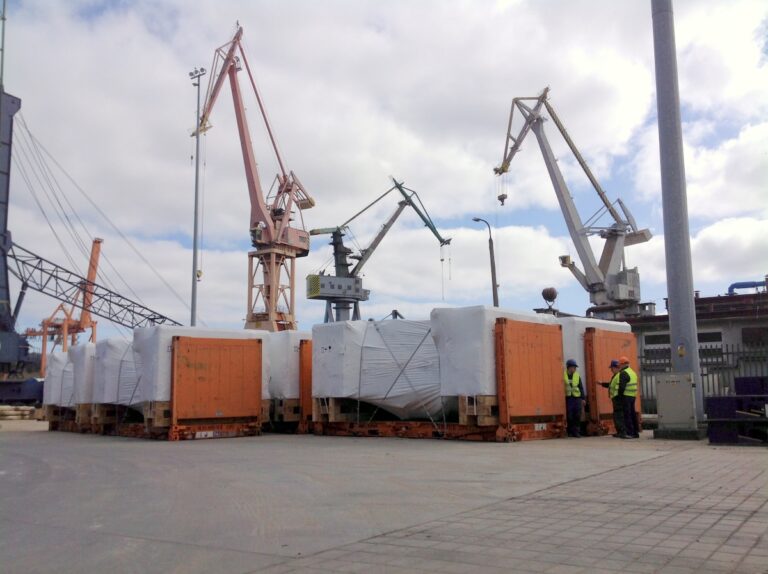
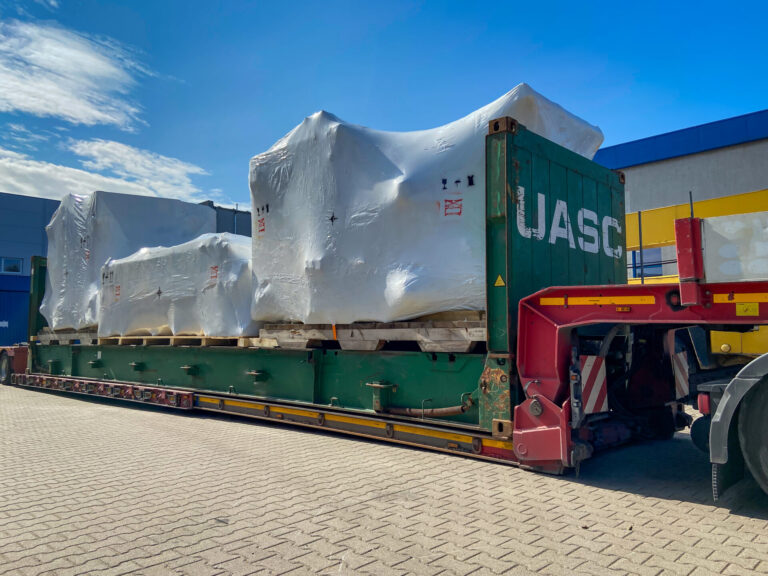
A flat rack is a platform without a roof or side walls, featuring stanchions at the shorter ends, which on many models can be folded down to floor level. It is used for loads that exceed the dimensions of a standard container – such as machinery, steel structures and large-scale components lifted by a crane from above or from the side – where unobstructed access to the load from all sides is essential during securing.
| Parameter | 20′ Flat Rack | 40′ Flat Rack | 40′ HC Flat Rack |
| Load length | approx. 5.9–6.0 m | approx. 12.0 m | approx. 12.0 m |
| Loading width | approx. 2.4 m | approx. 2.4 m | approx. 2.4 m |
| Height of the front/load | approx. 2.2–2.3 m | approx. 2.2–2.3 m | approx. 2.6 m |
| Approximate volume | approx. 31.9 m³ | approx. 58.6 m³ | higher than the standard |
| Tara | approx. 2,700–3,000 kg | approx. 4,200 kg | higher |
| Maximum load capacity | up to approx. 30–42 tonnes | up to approx. 40–45 tonnes | up to approx. 49 tonnes |
The variation in load capacity figures between manufacturers of this type of container is greater than for standard containers, therefore, when relocating a large-scale machine, one must always verify the specifications of the specific unit provided by the shipowner, rather than relying on average values from publicly available tables.
The practical consequence of the absence of side walls is that the entire weight of the load securing falls on the stowage – stowage timber, high-strength straps and wedges securing the load to the twist-lock sockets in the platform floor. A 15-tonne machine on a 40-foot flat rack requires a lashing system designed to distribute the inertial force generated by the ship’s roll – unlike in a closed container, where the side walls further restrict cargo movement, on a flat rack, this function must be entirely taken over by the lashing. For this purpose, IPPC-certified dunnage timber is primarily used, which secures the cargo and creates separation between the individual items lashed to the platform, whilst the service of preparing and securing the cargo on a container – regardless of its type – is described on the container stowage page.
4. Open-top containers
The open-top container retains the side walls of a standard container but has a removable roof with a tarpaulin, which allows tall or long items to be loaded from above using a crane, without the need to dismantle the machinery into smaller components.
| Parameter | 20′ Open Top | 40′ Open Top |
| Internal length | approx. 5.9 m | approx. 12.03 m |
| Internal width | approx. 2.35 m | approx. 2.35 m |
| Headroom (to the roof rail) | approx. 2.35 m | approx. 2.35 m |
| Maximum load capacity | approx. 21–28 t | approx. 26–30 tonnes |
The height of the cargo in an open-top container may exceed the height of the container itself if the tarpaulin is removed or partially opened – in which case the cargo protrudes above the container, which must be declared as oversized cargo (out of gauge, OOG) and affects how the cargo is stowed on the ship, as such a container must be positioned on the highest level in a given section so as not to interfere with containers stacked above it. This solution is particularly useful when relocating tall but narrow machinery – for example, press brakes or milling towers – whose height prevents them from being transported in a closed container, but whose width still fits within the standard width of 2.35 m.
5. How many pallets fit into a 20′ and 40′ container?
The number of pallets depends on the type of pallet – Euro (800 x 1200 mm) or industrial (1000 x 1200 mm) – and on whether the load can be stacked.
| Container | Euro pallets (800 x 1200 mm), single layer | Industrial pallets (1000 x 1200 mm), single layer |
| 20′ Standard | 9–11 | 9–10 |
| 40′ Standard / 40′ HC | 23–25 | 20–21 |
The difference in the number of Euro pallets (9 versus 11 in a 20-foot container) is due to the layout – stacking pallets across the width of the container allows more units to be fitted than stacking them lengthways, but requires precise planning to ensure the internal width of 2.35 m is not exceeded. In freight forwarding practice, 11 Euro pallets for a 20-foot container and 24–25 for a 40-foot container are generally taken as a safe estimate for standard spacing without having to adjust the layout. For non-standard cargo dimensions, custom-made pallets – designed to fit the specific spacing inside the container rather than the universal EPAL standard – are often a good solution.
For light and low-profile goods (up to approx. 1.0–1.1 m in height of a loaded pallet) in a 40′ HC, it is possible to stack two layers of pallets, which – whilst remaining within the weight limit – can double the number of pallets; in practice, this amounts to approx. 46–50 Euro pallets in two layers. The limiting factor here is not space, but the container’s maximum load capacity (approx. 26,300–26,500 kg) and the strength of the bottom pallet to withstand the pressure from the upper layer.
Calculation example: a Euro pallet carrying 400 kg of goods, stacked in a single layer of 24 pallets in a 40′ HC container, gives a total of 9,600 kg – which is only 36 per cent of the available load capacity. In this case, stacking a second layer (a further 24 pallets, a further 9,600 kg) gives a total of 19,200 kg, still below the 26,300 kg limit; therefore, the height dimension remains the only real constraint, not the weight. The opposite situation – a pallet with 1,100 kg of goods – approaches 26,400 kg with just a single layer of 24 pallets, thus exceeding the load capacity limit, even though there is still space left in the container. This simple calculation shows that when planning a load, two parameters – volume and mass – must be taken into account simultaneously, because depending on the density of the goods, the limiting factor changes radically.
6. Which container to choose – selection guidelines
20′ Standard – general cargo, heavy loads with a small volume, where the limit is weight rather than volume – e.g. weights, cast steel components, pallets with metal components.
40′ HC – the default choice for most palletised loads and medium-sized machinery, offering the best volume-to-freight-cost ratio per unit of cargo.
Flat rack – machinery, steel structures and loads that exceed the width or height of a closed container; loading from the side or from above using a crane, where unobstructed access to the lashing points is essential.
Open top – tall or long loads requiring loading from above, whilst protecting the container’s side walls from mechanical damage and, to some extent, from the elements.
When relocating industrial machinery of non-standard dimensions, the choice of container type should be based on the actual dimensions and weight of the machinery, including its transport packaging, rather than on the assumption that ‘it will fit into a standard 40-foot container’. An incorrect estimate at this stage leads to the need for last-minute transhipment to a flat rack, the loss of space on a vessel that has already been booked and – in the worst-case scenario – the need to wait for the next available booking slot, which on some ocean routes means a delay measured in weeks, not days.
Summary
Choosing the right container is a decision that must be made on the basis of three variables simultaneously – the load’s dimensions, its weight and the method of loading – rather than on the basis of just one of them in isolation from the others. The standard 40′ HC remains the universal benchmark for most palletised cargo and medium-sized machinery, but when the width, height or lifting method of the cargo precludes loading via the side doors, a flat rack or open-top container becomes the only viable solution.
It is worth bearing in mind that the dimension and load capacity tables published by different shipping lines vary by a few per cent – and in the case of flat racks, by as much as a dozen or so per cent – therefore, before finally booking a container for a specific load, you should always confirm the technical specifications of the vessel that the carrier will actually provide at the terminal. The same rigour applies to calculating the number of pallets – it is not only the single-layer arrangement that is decisive, but also a parallel check of the weight limit, because, depending on the density of the goods, it is weight, not space, that can be the limiting factor for loading.
When planning the shipment of a machine, a production line or an oversized load, it is advisable to consult on the choice of container and stowage arrangements before booking the transport – this helps to avoid last-minute reloading and losses resulting from a lack of space on the vessel. You can find the relevant contact details on the Danpol contact form page.