
Export packaging of hydraulic systems and control cabinets
We often see the same pattern: a customer invests hundreds of thousands of zlotys in a hydraulic system or a control cabinet, and then wants to cut corners on packaging. The result? Corrosion on valves after three weeks of sea transport, a cracked HMI panel following handling at the port, and a delay of several months in the commissioning of the production line at the customer’s site. In this article, we share our experience – showing how to properly protect these demanding components for export.
Why does the export packaging of hydraulic systems and control cabinets require a specialist approach?
Hydraulic systems are precision assemblies comprising pumps, directional control valves, actuators, valve blocks and pressure lines. Manufacturing tolerances are measured in micrometres – even the slightest scratch on a valve’s sealing surface leads to leaks and costly downtime. Corrosion inside the hydraulic cylinder, in turn, generates metal particles that damage pumps and valves throughout the entire circuit.
Control cabinets contain sensitive electronics: PLCs, HMI panels, inverters, programmable relays and hundreds of cable connections. They are susceptible to shocks, moisture, electrostatic discharge (ESD) and temperature fluctuations. In our experience, we have seen control cabinets where, following a four-week sea voyage, condensation inside the container led to a short circuit on the terminal blocks. The cost of the repair exceeded the cost of the transport itself.
Incorrect export packaging of these components leads to complaints, delays in commissioning the installation and a loss of customer confidence. In extreme cases, the goods are completely lost. Professional export packaging is not a cost – it is an insurance policy protecting an investment often worth several hundred thousand zlotys.
Protective materials used in our export packaging
VCI film – active corrosion protection for metals
VCI (Volatile Corrosion Inhibitors) film is the cornerstone of export packaging for any metal component. The volatile corrosion inhibitors it contains are released within the sealed packaging and settle on metal surfaces, forming an invisible protective layer at a molecular level. Hydraulic components – cylinders, pistons, valves, manifold blocks – remain protected against oxidation even at relative humidity levels exceeding 90%.
When it comes to hydraulic systems, we select VCI film because a single assembly typically contains steel, aluminium and brass components, and these are often chrome-plated. Standard VCI film, which is designed exclusively for steel, will not protect aluminium surfaces – this is one of the most common mistakes we encounter among packaging companies with no experience in hydraulic components.
Aluminium barrier film (ALU) and vacuum packaging
The ALU barrier film acts as an outer layer that hermetically seals the interior of the packaging off from atmospheric factors – moisture, gases and the salt content of sea air. It is resistant to punctures, tears and UV radiation. When combined with air evacuation (vacuum packaging), it creates a sealed system in which the VCI film operates with maximum effectiveness. In our projects, vacuum packaging in AL-VCI film with moisture absorbers ensures protection of the goods for up to 24 months – which is crucial for deliveries to Asian or South American markets, where transport times, including port storage, can be very long.
Desiccants and packaging condition indicators
Inside each export package, we place moisture absorbers – silica gel or bentonite sachets – which absorb excess moisture from the enclosed space. We determine the quantity of absorber based on the volume of the package and the planned transport time. In addition, we use humidity indicators, which allow the recipient to immediately verify whether the conditions inside the packaging have been compromised. A change in the indicator’s colour from blue to pink signals that the permissible moisture level has been exceeded.
ISPM 15 shipping crates – the cornerstone of safe exports
ISPM 15 certification – why is it essential?
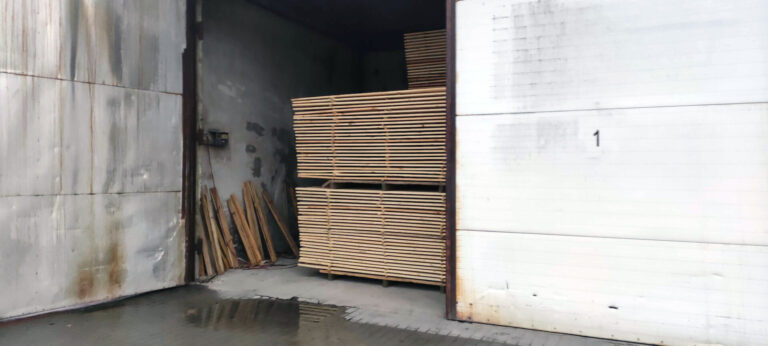
International Plant Protection Convention Standard ISPM 15 sets out the requirements for wooden packaging material in international trade. Every shipping crate used for export must be made of heat-treated (HT) wood and marked with a certified IPPC stamp, which must be permanently and legibly imprinted. Without this marking, the goods may be detained at customs clearance at the port of destination – we have seen cases where the absence of an ISPM 15 stamp has resulted in delays of several weeks and storage costs at the port amounting to tens of thousands of euros.
We have our own ISPM 15-certified facility, which enables us to manufacture custom-made transport crates – tailored to the specific dimensions and weight of the hydraulic systems and control cabinets being packed. This allows us to cut out the middleman and gives us full control over the quality of the timber, the construction and the delivery times.
Designing a container for a specific load
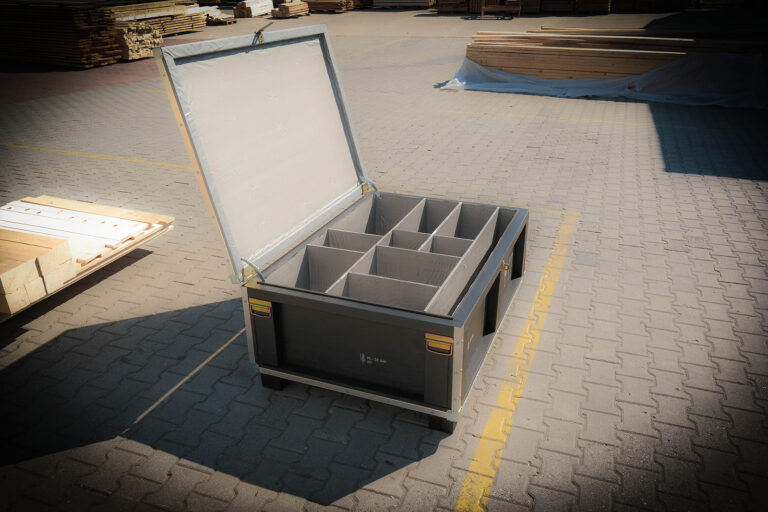
Every hydraulic system and every control cabinet has different dimensions, weight and centre of gravity. We design crates on a case-by-case basis, taking into account: the load’s dimensions, its total weight, the mode of transport (sea, air, road), container lashing requirements, and the specific requirements of the end customer and the destination port.
For heavy hydraulic units – weighing over 500 kg – we reinforce the enclosures with steel fittings, machine screws and additional corner bracing. The base is fitted with skids to allow handling by a forklift truck with the appropriate load capacity. For control cabinets, we use anti-vibration pads and shock absorbers to protect sensitive electronics from shocks during port handling operations, where accelerations can reach 3–4 g.
What is the export packaging process like at Danpol – step by step
We handle every export packaging order in accordance with a set procedure, developed on the basis of many years of experience and hundreds of completed projects. Below, we outline the individual stages – from the moment we receive the order to the dispatch of the finished consignment.
Stage 1: Inventory and photographic documentation
Before packing begins, we carry out a detailed inspection of the goods – similar to the loading inspection, which we offer as a separate service. We document the dimensions, weight, technical condition and any existing damage. On this basis, we select protective materials and design the transport crate. We produce photographic documentation at a resolution that allows for detailed analysis – this serves as proof of the goods’ condition prior to packing and provides valuable protection in the event of a transport claim.
Stage 2: Preparing the components
We clean metal surfaces in hydraulic systems to remove dirt, oil residues and moisture. We secure hydraulic ports, threaded holes and connectors with plugs. We tie up flexible hoses to prevent them from being damaged. In control cabinets, we check all moving parts – doors, ventilation flaps, DIN rails – and secure them to prevent them from opening accidentally. Loose components (documentation, accessories, spare fuses) are packed separately and placed inside the cabinet in labelled bags.
Stage 3: Application of VCI film and aluminium barrier film
First, we wrap the goods in VCI film, ensuring that all metal surfaces are fully covered. We then apply a barrier aluminium foil to create an airtight seal. Inside, we place desiccants in a quantity appropriate to the volume of the package, along with humidity indicators. When vacuum-packing, we pump the air out of the interior and check the seal of the package after 30 minutes – a drop in vacuum pressure would indicate a leak requiring repair.
Stage 4: Loading into the box and securing the load
We place the secured goods in a dedicated transport crate and secure them using transport straps, wooden wedges, PE foam padding or special brackets welded to the base. Key principle: the load must not shift inside the crate, even when tilted up to 45 degrees, as may occur during loading onto a ship. In the case of control cabinets, we secure them in a vertical position, in accordance with the manufacturer’s orientation arrows.
Stage 5: Closure, marking and documentation
Close the crate and secure it with screws or spiral nails. Affix labels to the outside containing the full details: recipient’s name, delivery address, gross and net weight, handling symbols (ISO 780 pictograms – ‘Do not tip over’, “Protect from moisture”, “Top/Bottom”) and ISPM 15 markings. We enclose a packing list in English, which is required for customs clearance.
Export packaging and mode of transport – what to look out for
Maritime transport – the biggest challenge
Sea transport poses the toughest test for export packaging. Humidity inside the container can exceed 90%, salty air accelerates corrosion, and dynamic stresses during storms and port handling can damage cargo that is not properly secured. For sea transport, we use full vacuum packaging in AL-VCI film, reinforced shipping crates and container desiccants installed inside the container itself. Equally important is the correct positioning and securing of the crates within the container – which is why we often combine packaging with container stowage services, ensuring comprehensive protection of the cargo from packaging through to loading.
Air freight – weight and time are the priorities
In air freight, it is essential to minimise the weight of the packaging whilst maintaining an adequate level of mechanical protection. We use lighter crates made of openwork timber or OSB boards, and we focus on protecting the goods against shocks and changes in atmospheric pressure. Air freight is usually chosen for urgent deliveries of control cabinets – when the delay in starting up the production line costs the customer more than the difference between sea and air freight.
Road transport within Europe
In road transport, anti-corrosion requirements are less stringent, but mechanical securing remains crucial. We use crates on pallets or dedicated platforms, and secure the load in accordance with standard EN 12195 on load securing for road transport. For domestic and intra-EU shipments, crates made of non-fumigated wood are often sufficient, which reduces packaging costs.
The most common mistakes in export packaging – what to avoid
Our many years of experience enable us to identify recurring mistakes made by companies that undertake export packaging themselves. Here are the most common ones:
Stretch film instead of VCI film. Stretch film provides only mechanical protection – it does not contain volatile corrosion inhibitors. During sea transport, rust can appear after as little as two weeks.
Inadequate securing of the load in the load compartment. A hydraulic system weighing 400 kg that is not secured will shift during sudden braking. This can result in damage to both the goods and the load compartment itself.
The hydraulic ports are missing their caps. Open ports allow moisture and contaminants to enter, which will permanently damage the precision components inside the system – proportional valves, gear pumps and distributors.
Failure to provide ESD protection for control cabinets. Electrostatic discharges can damage PLCs and inverters. The use of antistatic film and earthing is essential.
Wood without ISPM 15 certification. No IPPC stamp on the crate = goods held up at customs clearance. This is the most costly mistake, as it results in port storage charges and delays the entire project.
Frequently Asked Questions (FAQ)
How much does it cost to pack a hydraulic system for export?
The cost depends on several factors: the dimensions and weight of the goods, the mode of transport (sea freight requires full vacuum packing, which increases the price), the route and delivery time, and the recipient’s specific requirements. We prepare a quote on a case-by-case basis once we have received the goods specification – usually within 24 working hours. In practice, the cost of professional packaging usually amounts to 1–3% of the value of the goods being packaged.
How long does it take to process an export packaging order?
We complete standard orders – covering box design, production and packaging – within 3–5 working days. For larger projects (involving a dozen or several dozen units), we agree on a delivery date on a case-by-case basis. We have mobile packing teams that can carry out the service directly at the customer’s premises, thereby eliminating the need to transport the goods to our warehouse.
Can I wrap the goods in VCI film myself?
Technically, yes, but without experience it is easy to make mistakes: choosing the wrong type of VCI film that is unsuitable for the type of metal being protected, using an insufficient number of desiccants, or failing to seal the vacuum packaging properly. Any of these mistakes can render the entire protection ineffective. If the value of the goods exceeds several tens of thousands of zlotys, we recommend entrusting the packaging to a specialist.
How does packaging for sea freight differ from that for air freight?
Sea freight requires full vacuum packaging in AL-VCI film, using reinforced crates and container desiccants – due to high humidity, salinity and long transit times. In air transport, the priority is low packaging weight (lighter crates, fewer protective materials), but this requires better protection against shocks and pressure changes. The cost of packaging for sea transport is usually 20–40% higher.
What is an ISPM 15 certificate and is it mandatory?
ISPM 15 (International Standards for Phytosanitary Measures No. 15) is an international standard governing the requirements for wooden packaging material in international trade. The wood must undergo heat treatment (HT) and be marked with an IPPC stamp. The certificate is mandatory for exports to virtually all countries worldwide. Without this certificate, goods may be detained at the border or at the port of destination.
Do you offer on-site packaging at the customer’s premises?
Yes. We have mobile packing teams equipped with a full range of tools: barrier film sealing machines, vacuum pumps, carpentry tools and packing materials. We provide packing services at our clients’ premises throughout Poland, and for larger projects, across Europe as well. On-site packaging eliminates the risks associated with the additional transport of unsecured goods.
Summary
The export packaging of hydraulic systems and control cabinets is a process that requires a combination of engineering expertise, knowledge of international standards and practical experience. Carefully selected protective materials – VCI film, aluminium barrier film, desiccants – combined with ISPM 15-certified transport crates ensure safe delivery even to the most remote export markets.
The key is to work with a partner who treats every order as unique – designing packaging tailored to the specific goods, transport route and the recipient’s requirements. At Danpol, we handle the entire process under one roof: from crate design, through production and packing, right through to customs documentation. Take a look at our full range of services – which also includes machine relocation, dunnage timber and loading inspections.
Do you need professional export packaging for hydraulic systems or control cabinets? Get in touch with us– we’ll provide you with a bespoke quote tailored to your goods and transport route.